



Successfully Submitted
What Are the Main Parts of a Robot and How Do They Work Together?
By Vaishnavi E
July 28, 2026 (Last Updated) | 6 mins read
Have you ever watched a robot vacuum move around a room, cleaning every corner without bumping into furniture? It almost feels like it knows the room by heart. The answer lies in the main parts of a robot, the building blocks that let a robot sense, think, and move on its own.
A robot does not have magic inside it. It has parts, just like our body has eyes, a brain, and hands. Each part has its own job. In this blog, we will break down the main parts of a robot and understand how robots work.
To Understand the Main Parts of a Robot: Think of a Robot Like a Living Being
Before we jump into the technical parts, here is an easy way to picture it. Think about your own body.
You have a brain that thinks and makes decisions, eyes and ears that sense the world around you, and muscles that let you run, jump, and lift things. You eat food to get the energy that keeps you going.
Know more: What Is Robotics and How Are Robots Changing the World Around Us?
A robot works in almost the same pattern, just with different names for these parts. These are the five main components of a robot:
- A controller (brain) to make decisions
- Sensors to sense the world around it
- Actuators to move
- A battery (power source) to stay active
- A frame or chassis (body) to hold everything together
Once you understand these five parts, you can understand almost any robot out there, from a small robot vacuum in your living room to a giant robotic arm in a car factory. Let’s explore the main parts of a robot one by one.
Want to go from reading about robots to actually building one? Our Advanced AI Robotics Course for Kids will show you how, step by step.
1. The Brain: Controller or Microcontroller
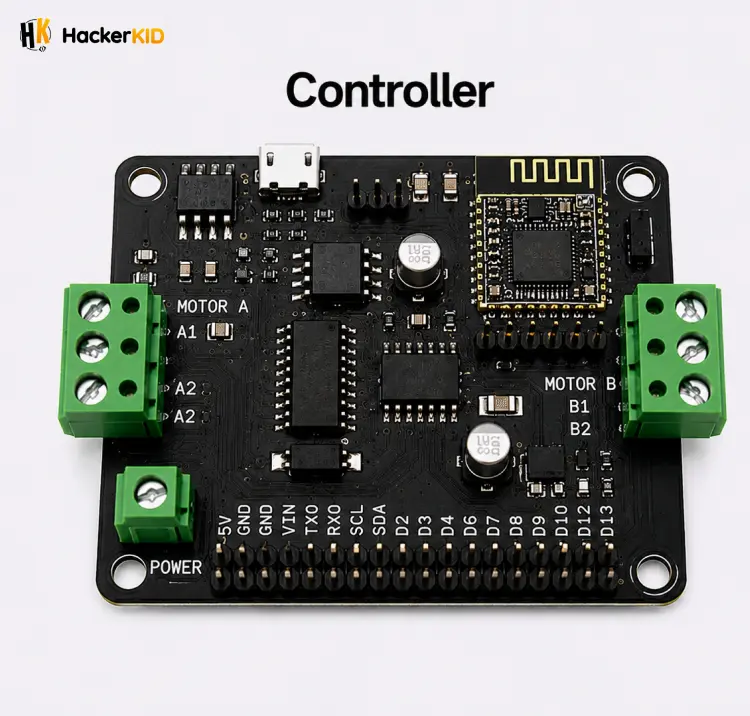
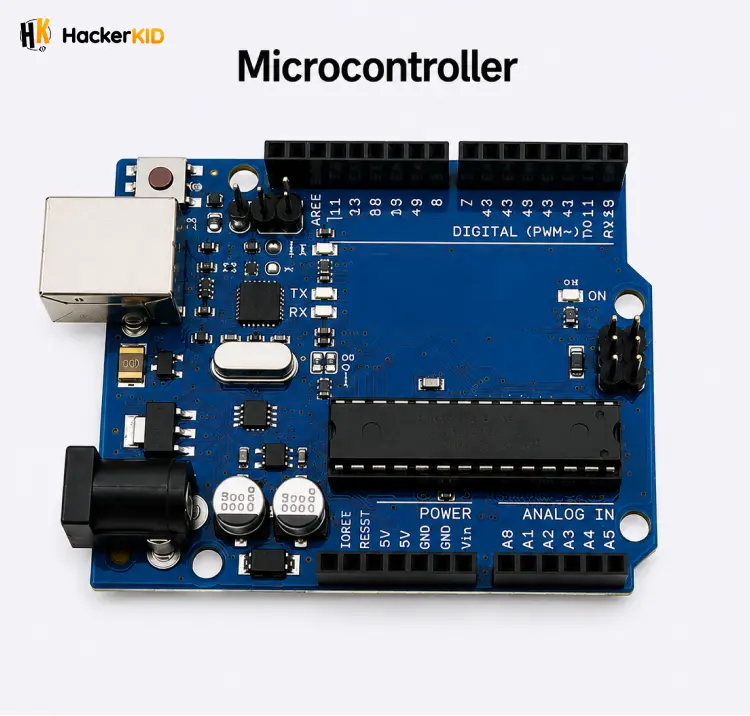
Every robot needs something to think for it, and this part is called the robot controller. In smaller robots that beginners build, this is often a microcontroller board like Arduino or Raspberry Pi. The controller receives information, decides what to do about it, and then sends out instructions. It works almost exactly like our brain does.
Think about what happens when you accidentally touch something hot. Your skin senses the heat, sends a signal to your brain, and your brain instantly tells your hand to pull away. A robot controller does the same kind of job, just with electronic signals instead of nerves.
Real-time example: Inside a robot vacuum cleaner, there is a small controller that is constantly asking itself questions. Where am I right now? Is there a wall nearby? Should I turn left or right? It takes in all the information coming from different parts of the robot and decides the next move, in a fraction of a second, over and over again.
2. The Senses: Sensors
A robot cannot make good decisions if it has no idea what is happening around it. That is exactly where robot sensors come in. Sensors act like the eyes, ears, and skin of a robot, constantly collecting information from the world outside.
There are many types of sensors, and each one senses something different. Here are a few common ones learners come across in beginner robotics:
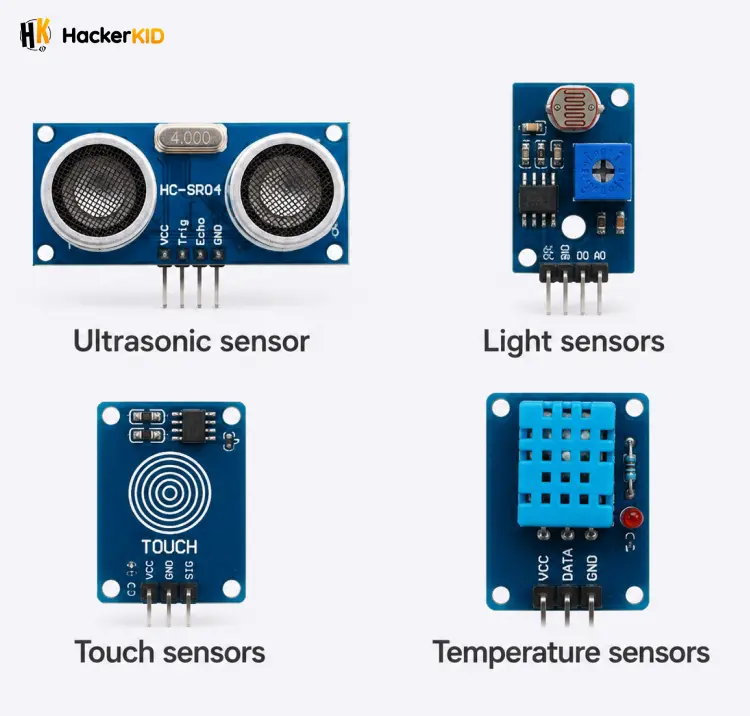
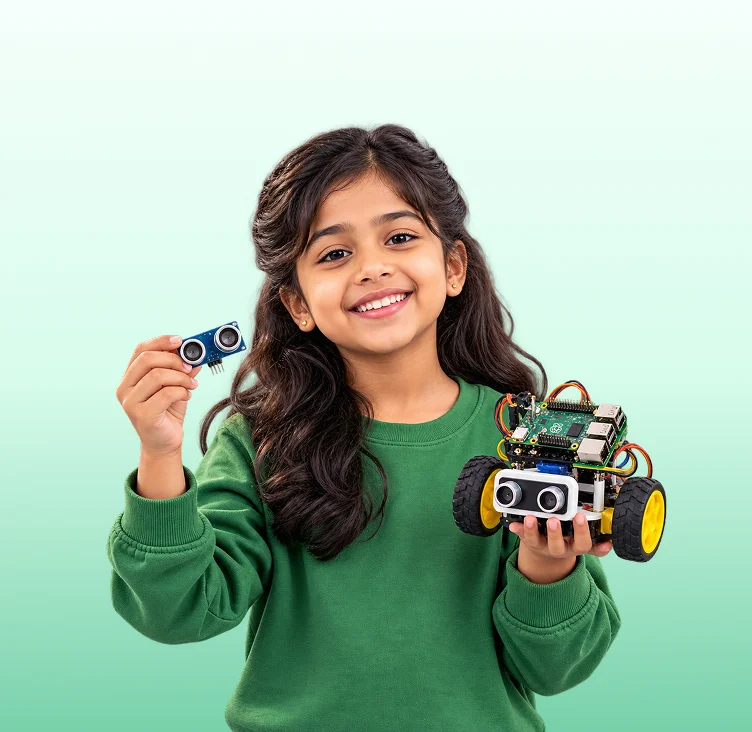
- Ultrasonic sensors detect how far away an object is, much like how a bat senses things in the dark
- Light sensors detect how bright or dark it is around the robot
- Touch sensors detect when the robot bumps into something solid
- Temperature sensors detect heat or cold in the surroundings
Real-time example: When a robot vacuum comes close to a wall, its ultrasonic sensor sends out a sound signal and waits for it to bounce back. If the signal returns quickly, the robot understands that a wall is close by and needs to change direction.
This happens so fast that you would never notice it, but it is happening constantly in the background.
Without sensors, a robot would be moving around completely blind, crashing into everything in its path. Sensors are what give a robot awareness of its surroundings, just like our own senses give us awareness of ours.
3. The Muscles: Actuators and Motors
Once the brain decides what needs to be done, something has to actually go and do it. That job belongs to robot actuators. Actuators are the parts that create movement, and the most common actuator that beginners work with in robotics is a motor.
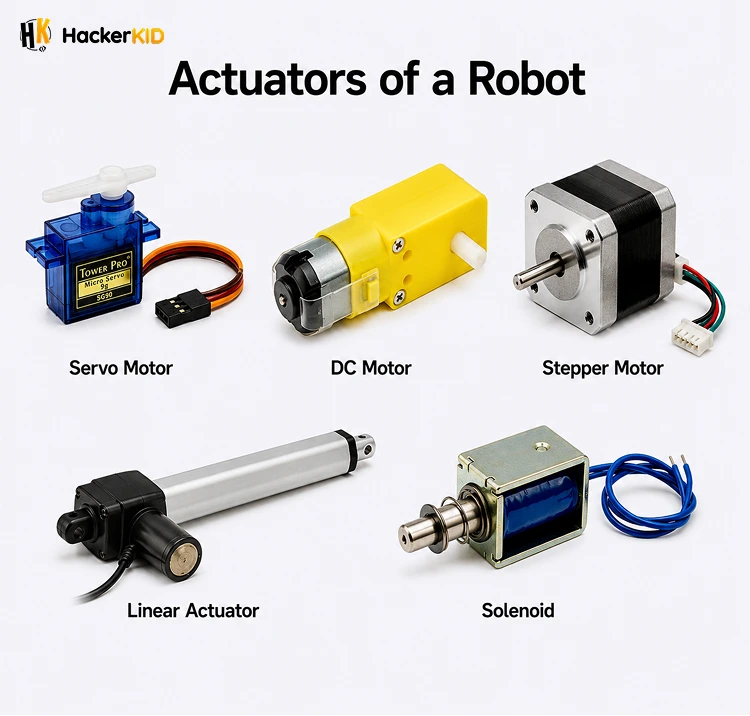
Motors help wheels spin, arms lift, and grippers open and close. Without actuators, a robot would just sit there thinking away but never actually moving, a bit like knowing you should get up and go for a run but never actually getting off the couch.
Real-time example: In our robot vacuum example, once the sensor tells the brain that a wall is close, the controller instantly sends a signal to the motors. The motors slow down one wheel and speed up the other, and the robot smoothly turns away before it can crash.
The same idea applies to a robotic arm in a factory, where motors in its joints let it bend, twist, and lift, much like our elbow and shoulder muscles move our arm.
4. The Power Source: Battery
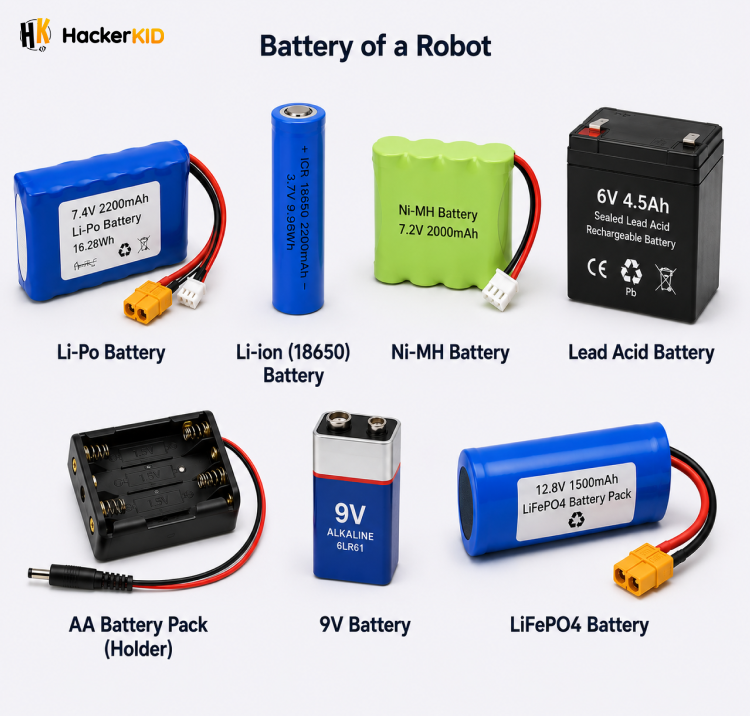
Nothing works without energy, not even robots. The power source, usually a battery, gives energy to every other part of the robot.
The controller needs power to think, the sensors need power to sense, and the motors need power to move. If the battery runs out, every part simply stops, no matter how well designed it is.
Real-time example: A robot vacuum charges itself on a charging station whenever it is not cleaning. Once fully charged, it uses that stored energy to move around and clean the house.
When the battery starts running low, the sensors detect it, the brain understands what that means, and the robot automatically finds its way back to the charging station on its own. This is a great example of all five parts working together at the same time.
5. The Body: Frame or Chassis
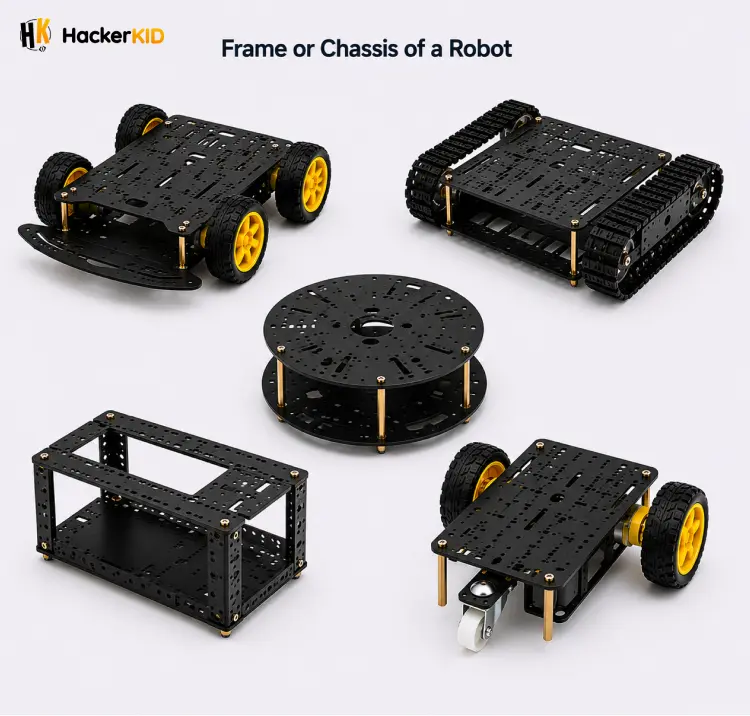
The frame, also called the chassis, is the structure that holds all the other parts together, like the robot’s skeleton. Without a strong frame, the sensors, motors, and brain would not stay connected or protected.
The frame also decides the shape and purpose of the robot. A robot vacuum has a round, flat frame so it can move smoothly and even slide under furniture.
A robotic arm has a long jointed frame so it can reach out, rotate, and bend at different angles. The frame is always designed based on the job the robot needs to do.
How All the Main Parts of a Robot Work Together
This is where you really see how robots work. Let us put everything together using our robot vacuum example, step by step:
- The battery gives power to the whole robot.
- The sensors constantly check the surroundings for walls, furniture, or stairs.
- This information travels to the controller, the brain of the robot.
- The controller decides the next action, such as turning left, moving forward, or stopping.
- The controller sends a signal to the motors, telling them what to do.
- The motors move the wheels, and the robot changes direction or continues cleaning.
- Through all of this, the frame holds every part safely in place.
This cycle happens again and again, many times every second. That is what makes the robot feel almost smart, even though it is simply following a well organized loop of sensing, thinking, and acting.
Why Understanding This Matters
Once learners understand this simple loop of sense, think, and act, they can understand almost any robot in the world. A robotic arm in a car factory, a drone in the sky, or a robot dog follows the same basic pattern, only the sensors, motors, and frame design change based on the job.
Learning robotics is not about memorizing complicated machines, it is about understanding the main parts of a robot and the components of a robot working as one system, then getting creative with how they are combined.
Understanding a robot is just the first step, building one is where the real learning begins. Explore more in our Advanced AI Robotics Course for Kids and start creating with your own hands.
Final Thoughts
A robot may look like a complex machine from the outside, but once you break it down, it is simply five parts working as a team: a brain to think, sensors to sense, actuators to move, a battery to power everything, and a frame to hold it together.
When these main parts of a robot work together smoothly, a robot can clean a room, pick up objects, or even explore places humans cannot easily reach.
The next time you see a robot in action, try to spot these five parts. You might just start seeing robots in a whole new way.
FAQs
💬 Quick Answers 1. What are the main parts of a robot?
The main parts of a robot are the controller, sensors, actuators, a power source, and a frame. The controller acts as the brain, sensors help it sense its surroundings, actuators create movement, the power source gives it energy, and the frame holds everything together.
2. How do robots work?
A robot works in a simple loop of sensing, thinking, and acting. Its sensors collect information, the controller decides what to do with that information, and the actuators carry out the action, all in a fraction of a second.
3. What is the brain of a robot called?
The brain of a robot is called the controller, or microcontroller in smaller robots. It receives information, makes decisions, and sends out instructions to the rest of the robot, just like our brain does for us.
4. What are the different types of robot sensors?
Common robot sensors include:
Ultrasonic sensors – detect distance
Light sensors – detect brightness
Touch sensors – detect contact
Temperature sensors – detect heat or cold
Each type helps the robot understand a different part of its surroundings.
5. What is the difference between a sensor and an actuator?
A sensor helps a robot sense what is happening around it, like detecting a wall or a change in light. An actuator, on the other hand, creates movement, helping the robot act on what its sensors have detected.
6. What powers a robot?
A robot is powered by its battery, which is the power source. It gives energy to every other part, including the controller, sensors, and motors, so the robot can function properly.
7. Can a robot work without a controller?
No, a robot cannot work properly without a controller. Without it, the robot would have no way to process information or decide what action to take next.
Table of Contents
To Understand the Main Parts of a Robot: Think of a Robot Like a Living Being
How All the Main Parts of a Robot Work Together
Why Understanding This Matters
Final Thoughts
FAQs


Related Posts
10 Easy Robotics Projects for Kids to Try (Beginner Level)
You might feel building a robot is hard, but it is easier than you think. With just a few basic …
July 28, 2026 | 8 mins read
Read More
What Are Robot Sensors and How Do Robots Use Sensors to Interact With the World?
Close your eyes for a second. Now try to walk across your room. Hard, right? You might bump into a chair …
July 28, 2026 | 7 mins read
Read More
What Is Raspberry Pi for Kids and How Can Kids Use It to Build Robotics Projects?
Technology gives children exciting ways to create, experiment, and solve problems. Raspberry Pi for kids makes this possible by combining …
July 28, 2026 | 8 mins read
Read More